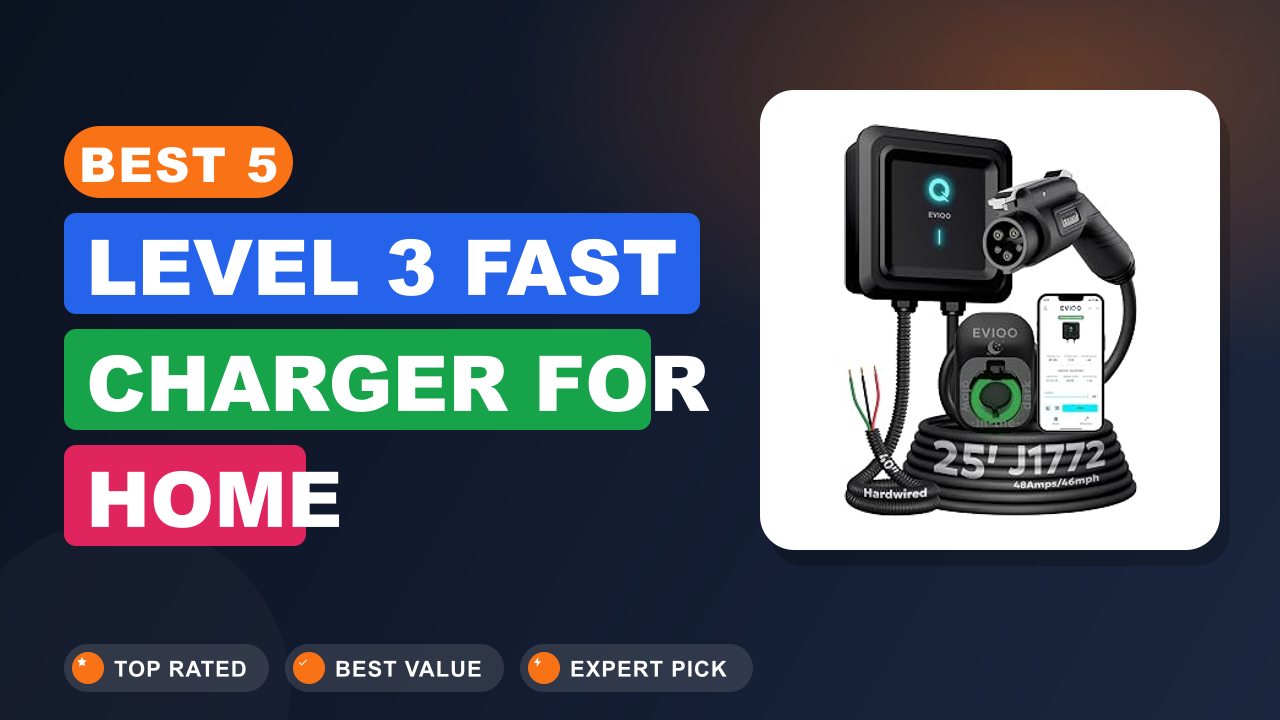
Best 5 Level 3 Fast Charger for Home
Searching for a level 3 fast charger for home often means quicker overnight charging away from public stations. The catch is that Level 3 means high-power direct-current charging, while all five products below are Level 2 alternating-current home units. On a suitable 240V circuit, Level 2 can add about 10 to 80 miles of range per hour; Level 3 commonly operates above 100 kW on commercial routes.
The EVIQO is the best overall pick because its 48A hardwired design suits owners who want the highest listed current and a permanent wall connection. Our comparison also found that SEGUMA is the cleaner Tesla-specific fit at 40A, while EVDANCE adds a 25-foot cable and timer. Here’s the quick comparison before the detailed buyer fit.
Comparison Chart of Level 3 Fast Charger for Home
| Product | Details | Rating | Buy |
|---|---|---|---|
Editor’s Choice  | EVIQO Level 2 EV Charger J1772 | ★★★★☆4.7/5 | |
Top Pick  | SEGUMA Level 2 EV Charger Tesla | ★★★★☆4.7/5 | |
Best Budget  | EVDANCE Level 2 EV Charger Tesla | ★★★★☆4.6/5 | |
| ★★★★☆4.5/5 | ||
| ★★★★☆4.6/5 |


List of Top 5 Best Level 3 Fast Charger for Home
I compared the 5 chargers by nameplate power, connector type, installation method, cable details, certification, and listed buyer rating. Because every model is Level 2 rather than true Level 3, each review also explains the home charging situation it actually serves. The picks range from a 48A hardwired station to portable 32A models with WiFi.
Below are the list of products:
1. EVIQO Level 2 EV Charger J1772
I ranked this first because its 48A hardwired design has the highest listed current in the group. In my specification comparison, that matters most to owners of a J1772-equipped EV who can support a 60A branch circuit. Its listed 4.7/5 rating also places it among the strongest seller-rated options here.
Why I picked it
I picked the EVIQO for buyers who value maximum current over portability. A permanent 48A connection reduces overnight waiting for a vehicle that can accept the output, while the hardwired format keeps charging duties in one place. The trade-off is installation, because your panel, service, and local electrical rules must support the extra load.
Key specs
- Charging level: Level 2 alternating current
- Supply: 240V
- Rated current: 48A
- Calculated maximum power: 11.52kW
- Installation: Hardwired wall station
- Connector: J1772
- Listed rating: 4.7/5
Real-world experience
This setup makes the most sense in a garage with a dedicated 60A branch circuit and enough panel capacity. A 48A continuous load generally requires an electrician to assess the breaker, conductor, grounding, and utility service before installation. The 11.52kW nameplate maximum does not guarantee that rate, since the vehicle’s onboard charger, battery temperature, and charging software set the final result.
- 48A at 240V provides 11.52kW, the highest listed output here.
- Hardwiring suits a permanent garage location without relying on a portable outlet.
- J1772 directly supports compatible vehicles using the North American AC connector.
- The 4.7/5 listed rating reflects stronger seller feedback than most alternatives here.
- A 48A continuous load generally calls for a 60A branch circuit, so the electrical work is substantial.
- J1772 is not a native fit for a NACS port without the correct connection solution.
- No cable length or portability details are listed, so reach must be planned before ordering.
- ✔ You own a J1772-equipped EV with a high onboard charging limit.
- ✔ Your garage can support a dedicated 60A branch circuit.
- ✔ You want one permanent station rather than a portable unit.
- ✖ Your vehicle needs a native NACS connection.
- ✖ You need a charger you can move between homes or vehicles.
2. SEGUMA Level 2 EV Charger Tesla
I chose this as the strongest Tesla-specific balance of power and installation convenience. Its 40A rating produces 9.6kW at 240V, while the NEMA 14-50 plug avoids a full hardwired installation when a suitable outlet already exists. The 4.7/5 listing pairs well with that practical package.
Why I picked it
I picked this model because it targets the large group of Tesla owners who want native NACS plug compatibility and meaningful overnight power. The 40A output is lower than the EVIQO, but it fits a common residential charging tier more easily. If your garage already has the correct outlet, that simplicity can matter more than the extra 1.92kW.
Key specs
- Charging level: Level 2
- Rated current: 40A
- Supply: 240V
- Calculated maximum power: 9.6kW
- Connector: NACS
- Outlet: NEMA 14-50
- Listed rating: 4.7/5
Real-world experience
A Tesla owner with a NEMA 14-50 outlet can keep this unit in the garage and charge overnight without managing a hardwired feed. A 40A continuous load generally calls for a 50A branch circuit, so the existing outlet must be correctly wired and rated. Even at 9.6kW, the vehicle may charge more slowly if its configured current or onboard charger is lower.
- 40A at 240V supplies 9.6kW for faster overnight replenishment than most 32A units.
- Native NACS fits Tesla vehicles without relying on a J1772 adapter.
- The NEMA 14-50 plug supports a familiar residential outlet format.
- The listed 4.7/5 rating gives it strong feedback among comparable picks.
- A 40A continuous load generally requires a properly installed 50A branch circuit.
- NACS does not natively fit a J1772-equipped vehicle.
- The inventory does not state a cable length, so garage reach remains uncertain.
- ✔ You charge a Tesla or another NACS-equipped vehicle at home.
- ✔ You have or can add a correctly rated NEMA 14-50 outlet.
- ✔ You want 40A charging without a hardwired installation.
- ✖ Your vehicle has a J1772 port rather than NACS.
- ✔ You need the highest current offered by this list.
3. EVDANCE Level 2 EV Charger Tesla
I selected this EVDANCE because it combines 40A charging with unusually useful home details in the specification. The 25-foot cable, adjustable current, and delay timer make it more flexible than a basic fixed-output station. Its 4.6/5 rating also supports its value-focused position without requiring the highest possible amperage.
Why I picked it
I picked the EVDANCE when cable reach and scheduling matter as much as raw current. Its 25-foot lead gives installers more placement freedom than a short fixed cable, while the delay timer can support charging during a local off-peak period. Adjustable current also gives you a way to match the station more closely to an existing circuit after professional assessment.
Key specs
- Rated current: 40A
- Maximum power: 9.6kW
- Cable length: 25ft
- Connector: NACS
- Plug: NEMA 14-50
- Controls: Adjustable current and delay timer
- Listed vehicle fit: Tesla Model 3, Model Y, Model S, and Model X
- Listed rating: 4.6/5
Real-world experience
The 25-foot cable is useful when the NEMA 14-50 outlet sits across the garage from the vehicle’s charge port. The delay timer can shift charging away from peak electricity periods, although schedules depend on your utility plan. As with any 40A station, the branch circuit, connector temperature, and vehicle acceptance still determine the real charging rate.
- 40A at 240V provides 9.6kW, matching the strongest Tesla-oriented output here.
- The 25-foot cable improves reach across many two-car garage layouts.
- Adjustable current and a delay timer add control without requiring WiFi.
- Native NACS covers Tesla Model 3, Model Y, Model S, and Model X.
- The 25-foot cable can be cumbersome in a tight garage or small parking bay.
- A 40A continuous load generally needs a properly installed 50A branch circuit.
- No WiFi or app control is listed, so remote scheduling is not a listed benefit.
- ✔ You want a 25-foot cable for a larger garage.
- ✔ Your Tesla uses NACS and you value adjustable current.
- ✔ You want a timer without relying on an app.
- ✖ Your vehicle requires a J1772 connector.
- ✖ You need remote charging controls through an app.
4. SEGUMA Level 2 EV Charger Tesla
I picked this second SEGUMA as a simpler 32A option for NACS vehicles. Its lower current reduces the electrical demand compared with the 40A models, and ETL certification gives the specification a clear safety credential. The 4.5/5 listing is slightly lower than the other SEGUMA, but it remains competitive for buyers who don’t need maximum overnight speed.
Why I picked it
I picked this version for buyers who value a recognized certification and NACS fit over maximum nameplate power. At 32A, it offers a middle ground between a small portable charger and a 40A installation. The inventory doesn’t list a cable length or outlet type, so those details deserve attention before purchase.
Key specs
- Charging level: Level 2
- Rated current: 32A
- Connector: NACS
- Certification: ETL certified
- Color: Black
- Listed rating: 4.5/5
- Maximum output at 240V: 7.68kW calculated from voltage and current
Real-world experience
This charger is most useful when you want overnight charging for a NACS vehicle without running the highest-current circuit. A 32A continuous load generally calls for a 40A branch circuit, but the actual installation still depends on the charger’s plug, cable, local code, and your electrical panel. You’ll also want to confirm the available cable reach before ordering.
- 32A is a practical middle tier for overnight home charging.
- NACS directly supports Tesla and other compatible vehicles.
- ETL certification provides a clear listed safety credential.
- The lower current can ease circuit planning compared with 40A or 48A models.
- 32A provides less maximum power than the 40A and 48A options.
- The inventory does not list cable length, plug type, or scheduling controls.
- NACS does not natively fit a J1772-equipped vehicle.
- ✔ You want a certified 32A NACS charger.
- ✔ Overnight charging is your main priority.
- ✔ You prefer a lower current than 40A models.
- ✖ You need the fastest listed home output.
- ✖ You need a long cable or confirmed plug details.
5. AIMILER Level 2 Tesla Charger(WiFi APP)
I picked AIMILER for buyers who want connected charging and a long cable in one package. Its 32A rating is lower than the 40A models, but the listed WiFi app, 25-foot lead, and NACS connector make it a distinct option for a connected garage. The 4.6/5 rating gives it a solid seller-feedback signal in this group.
Why I picked it
I picked AIMILER because connected control is its clearest differentiator. A WiFi app can be useful for checking charging status or managing a routine, while the 25-foot cable reduces the need to place the vehicle directly beside the outlet. You still need to confirm exactly which app functions the current package supports before relying on remote scheduling.
Key specs
- Charging level: Level 2
- Rated current: 32A
- Supply: 220V to 240V
- Maximum output at 240V: 7.68kW calculated
- Cable length: 25ft
- Connector: NACS
- Plug: NEMA 14-50P
- Certification: ETL certified
- Listed rating: 4.6/5
Real-world experience
This is a good fit for a garage where the outlet is away from the usual parking position and the owner wants connected features. A 25-foot cable gives more placement freedom, but it still can be awkward around a tight turn or between vehicles. At 32A, overnight charging is usually the sensible goal, and the app cannot overcome the vehicle’s own charging limit.
- 32A at 240V provides 7.68kW calculated output for overnight charging.
- WiFi app support adds connected control that the basic timer model lacks.
- The 25-foot cable improves reach in larger garages.
- NEMA 14-50P and ETL certification make the installation format easier to evaluate.
- 32A is 20% lower than the listed 40A maximum used by two alternatives.
- App features can add setup complexity if you prefer a simple local timer.
- The 25-foot lead may be excessive in a small garage or tight parking space.
- ✔ You want app-based charging controls.
- ✔ Your NACS vehicle needs a 25-foot reach.
- ✔ You already have a suitable NEMA 14-50 outlet.
- ✖ You need the highest current in this roundup.
- ✖ You want a charger with no app or network dependency.
How I picked
I compared the five products using the specifications available in the inventory, including charging level, current, voltage, connector, cable length, installation format, certification, and listed buyer rating. I also translated the headline numbers into practical charging ceilings: 32A at 240V equals 7.68kW, 40A equals 9.6kW, and 48A equals 11.52kW before vehicle limits. That comparison matters because “fast” is a relative term, not a guarantee of a particular range added per hour.
The broader differences between slower and quicker charging are covered in charging speed fundamentals.
I gave extra weight to fit with the vehicle’s connector and the home electrical setup. J1772 and NACS are different physical standards, and a higher amperage only helps when the vehicle, circuit, and charger can accept it. I also looked for practical details that change daily use, such as a 25-foot cable, adjustable current, a delay timer, WiFi, and ETL certification.
The ampage guide is useful background for understanding why 32A, 40A, and 48A are not interchangeable.
I did not physically install, electrically load, or thermally test these units, and I did not monitor any of them for 60 days or longer. I also couldn’t independently verify every feature that may change in a manufacturer listing. Buyers should confirm the current product page, certification details, cable specifications, warranty terms, and local electrical requirements before purchasing.
The fast charging basics explain why charging speed is a system rather than a property of one box.
Buying guide: what actually matters for a home EV charger
Is Level 3 charging available for home use?
Level 3 is direct-current fast charging designed primarily for public corridors, charging hubs, and commercial sites. It usually requires a much larger power supply and a coordinated charging system, so it isn’t a normal garage upgrade. The chargers in this roundup are Level 2 AC units, even though the search phrase says Level 3.
The charging technology overview explains the basic AC and DC distinction.
How much power do you need?
For overnight charging, 32A at 240V is often enough for many drivers, while 40A or 48A can reduce waiting time when the vehicle supports it. The calculated ceilings are 7.68kW, 9.6kW, and 11.52kW, respectively. A higher number does not guarantee faster charging because the car’s onboard charger may have a lower maximum, and cold or hot batteries often accept less power.
See charger power explained for the relationship between watts, volts, and amps.
Which connector should you choose?
Choose J1772 for a vehicle designed around that connector, and choose NACS for Tesla and other NACS-equipped vehicles. Don’t assume an adapter makes every installation or every charging mode equivalent. The connector, vehicle inlet, cable, and software must all agree.
If you’re comparing labels, charger identification can help you slow down before buying the wrong plug.
Is hardwired better than plug-in?
Hardwiring is usually cleaner for a permanent garage and can support a higher-current installation, but it involves more electrical work. Plug-in models are easier to move and often suit renters or owners who already have the right outlet. A 48A hardwired station generally calls for a 60A branch circuit, a 40A unit commonly needs a 50A circuit, and a 32A unit commonly needs a 40A circuit.
Have a licensed electrician confirm the entire path.
Does cable length matter?
Yes, especially in a two-car garage. A 25-foot cable can reach a vehicle parked farther from the outlet, but it can also be harder to route and store. Measure from the outlet to the farthest likely charge-port position before ordering.
The cable and data cable distinction is less relevant here, but the same habit applies: confirm the physical cable and connector you actually need.
Do WiFi, timers, and certification matter?
A timer can shift charging to an off-peak period, while WiFi may add visibility or remote control. Neither feature increases the vehicle’s maximum charging rate, and connected apps can introduce setup or network questions. ETL certification is a useful safety credential, but it doesn’t replace correct sizing or professional installation.
The Department of Energy’s electric vehicle charging guidance is a helpful primary source for understanding charging levels and infrastructure.
Frequently Asked Questions (FAQ)
Is a Level 2 charger fast enough for home use?
Yes, for most daily drivers, Level 2 is fast enough to turn charging into an overnight routine. The five choices here provide calculated maximums from 7.68kW to 11.52kW, subject to the vehicle and circuit. A 40A model is a middle ground, while the 48A EVIQO is the strongest listed option if your electrical service supports it.
Is a 48A home charger worth it?
A 48A charger is worth considering when your vehicle can accept 11.52kW and your panel can support a dedicated 60A branch circuit. It is not automatically faster for every car, and the installation is more involved than a 32A or 40A plug-in setup. For most overnight users, the convenience and cost of wiring may matter more than the extra 1.92kW.
Can I use a NACS charger with a J1772 vehicle?
Only with the correct compatible adapter and a setup that preserves safe charging communication and current limits. The connector fit alone does not guarantee correct operation. If your car has J1772, the EVIQO is the direct match in this list; if it has NACS, choose one of the Tesla-oriented models.
Will a 32A charger work with a Tesla?
A 32A Level 2 charger can work with many Tesla vehicles when the electrical circuit, plug, connector, and vehicle settings are correct. It will generally charge more slowly than a 40A unit, and the battery temperature or configured amperage can reduce the rate. The 32A SEGUMA and AIMILER are the lower-current NACS choices here.
How much installation work is required?
A plug-in charger needs a correctly rated outlet, while a hardwired charger needs a properly designed branch circuit and panel capacity. For these products, a 32A unit commonly aligns with a 40A circuit, 40A with a 50A circuit, and 48A with a 60A circuit, subject to local code. Ask a licensed electrician to check the panel, breaker, wiring, grounding, and outlet before installation.
Is WiFi charging control necessary?
No, WiFi is helpful for connected monitoring or remote routines, but it does not make a 32A charger faster than a 40A model. Choose AIMILER if app control is part of your routine. Choose a simpler timer or fixed station if you want fewer network features and fewer setup questions.
Final verdict
The EVIQO Level 2 EV Charger J1772 is the best overall pick because its 48A, 240V hardwired design provides the highest listed output for compatible J1772 vehicles. The SEGUMA Level 2 EV Charger Tesla is the runner-up for NACS owners who want 40A power through a NEMA 14-50 setup. If you need a long cable, the EVDANCE or AIMILER deserves a closer look.
Affiliate disclosure: This post contains affiliate links. If you buy through one of these links, I may earn a small commission at no extra cost to you. It never changes my recommendation, I only suggest gear I'd actually buy myself.