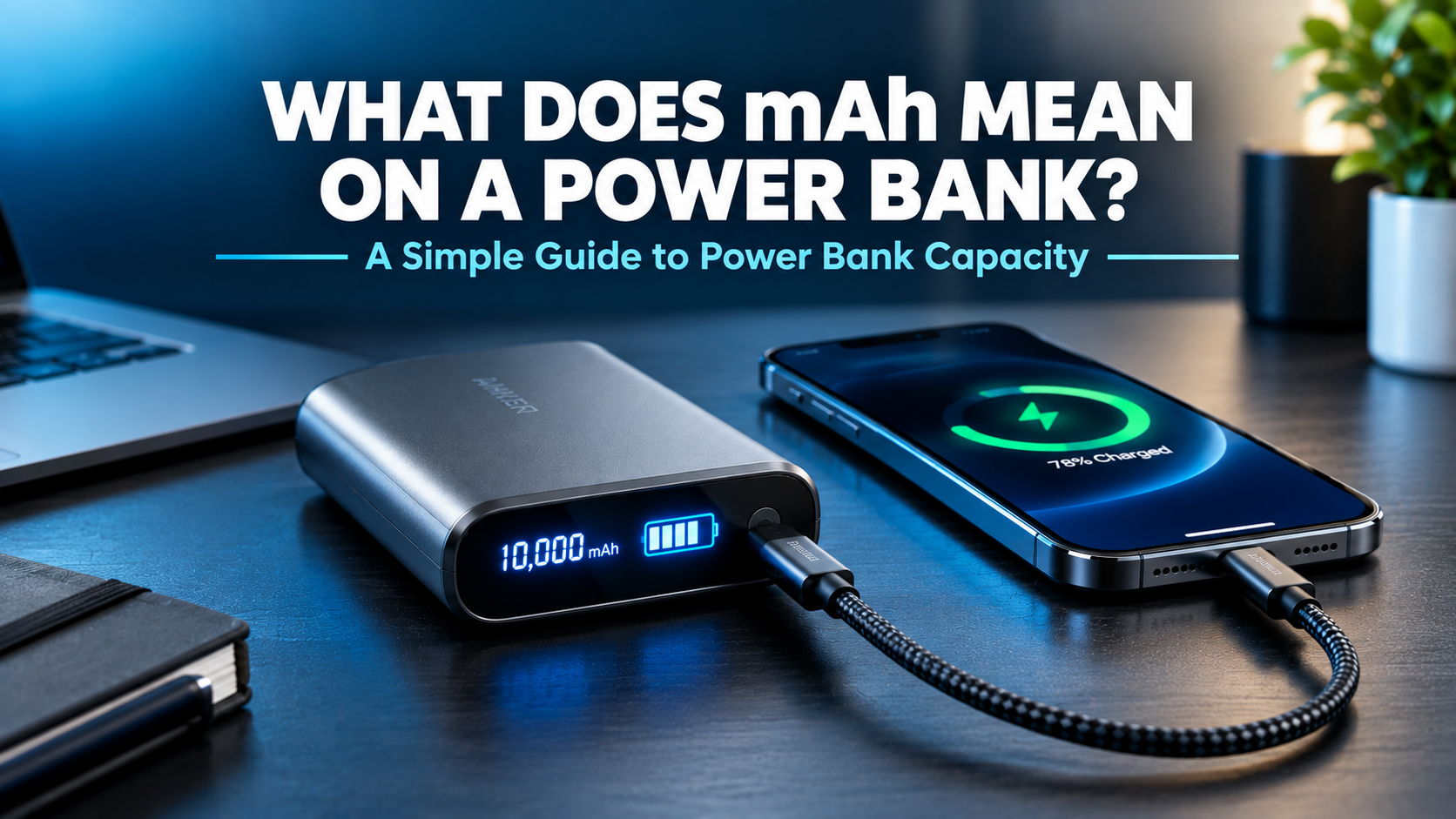
What Does Mah Mean On A Power Bank: Simple Guide 2026
mAh on a power bank measures how much charge the battery can hold, and a higher number means more power for your devices. Understanding this little label is the key to picking a power bank that actually keeps your phone alive through a long day.
Let me walk you through what mAh really means, why it matters more than you think, and how to avoid the most common mistakes people make when buying one. I've tested plenty of these little bricks over the years, and I'll share what I've learned the hard way so you don't have to.
The Basic Definition of mAh
mAh stands for "milliampere hour." Think of it as the size of the fuel tank in your power bank. The bigger the number, the more electrical charge it can store and deliver to your gadgets.
One mAh means the battery can supply one milliampere of current for one hour. So a 10,000 mAh power bank can theoretically deliver 10,000 milliamps for one hour, or 1,000 milliamps for ten hours. It is a unit of capacity, not speed, which is a common mix-up.
When you see a power bank labeled 20,000 mAh, that simply means it has a larger energy reserve than a 5,000 mAh model. Simple as that.
Why mAh Matters When Choosing a Power Bank
The mAh rating directly affects how many times you can charge your devices. A higher mAh rating means more charging cycles before the power bank itself runs dry.
Let me break it down with real numbers. A typical smartphone has a battery around 4,000 to 5,000 mAh. A 10,000 mAh power bank should charge that phone roughly once or twice. A 20,000 mAh bank might get you three or four charges depending on efficiency losses.
But here is the catch. The actual usable capacity is always lower than the advertised number. Some energy is lost as heat during the transfer, and the conversion from the power bank's voltage to your phone's required voltage eats up some of that stored power.
In my experience, you usually get about 60 to 70 percent of the rated capacity in real-world use. So that 10,000 mAh pack might actually deliver closer to 6,500 mAh to your device.

How mAh Relates to Your Device's Battery
Every rechargeable device has its own battery capacity measured in mAh. Your phone, tablet, wireless earbuds, and smartwatch all have different ratings. Matching the power bank capacity to your needs starts with knowing your device.
To estimate how many charges you will get, take the power bank's mAh rating, multiply it by 0.65 to account for efficiency losses, then divide by your device's battery size. The number you get is roughly how many full charges to expect.
For example, if you have a 10,000 mAh power bank and a phone with a 4,000 mAh battery, the math looks like this:
- 10,000 mAh times 0.65 equals 6,500 mAh of usable power
- 6,500 mAh divided by 4,000 mAh equals about 1.6 full charges
This is why a small 5,000 mAh power bank is great for a quick top-up, while a 20,000 mAh monster is better for camping trips or long flights.
mAh vs. Other Power Bank Specs You Should Know
mAh is not the only number that matters. Voltage, wattage, and charging speed all play a role in how useful a power bank really is.
Most power banks run on 3.7 volts internally, but they output 5 volts through USB. This voltage conversion is where some of that energy loss happens. That is why two power banks with the same mAh rating can perform differently if one has better internal circuitry.
Wattage, measured in watts, tells you how fast the power bank can charge your device. A 10,000 mAh power bank with 18W output will charge your phone much faster than one with 10W output, even though they hold the same amount of energy.
Then there is the question of battery cells. Quality lithium-polymer cells tend to last longer and hold their capacity better than cheaper lithium-ion cells. After a year of daily use, a good cell might retain 80 percent of its original capacity, while a cheap one might drop to 50 percent.
Common Misconceptions About mAh on Power Banks
One of the biggest myths is that a higher mAh always means a better power bank. That is not entirely true. A 30,000 mAh power bank that weighs a pound and takes six hours to recharge is not better than a 10,000 mAh one that slips into your pocket and refills in two hours.
Another common mistake is comparing mAh ratings across different voltages. Some power banks list their capacity at 3.7 volts, while others rate at 5 volts. The 3.7V rating is the true battery capacity, but the 5V rating is what you actually get at the USB port. Always check which voltage the mAh refers to.
I have also seen people assume that all the energy in a power bank makes it to their device. As I mentioned earlier, efficiency losses are real. Heat, voltage conversion, and cable quality all eat into that advertised number. A good rule of thumb is to expect about two-thirds of the rated capacity in actual charging power.
How to Pick the Right mAh for Your Lifestyle
Choosing the right capacity depends on how and where you plan to use your power bank. There is no one-size-fits-all answer here.
For daily commutes and light use, a 5,000 to 10,000 mAh power bank is usually plenty. It will fit in a pocket or small bag, weigh almost nothing, and give your phone at least one full charge. This is what I carry on most days.
For travel, hiking, or long days away from an outlet, go bigger. A 20,000 mAh power bank strikes a nice balance between capacity and portability. It can charge a phone four or five times and still fits in a backpack. I never leave for a trip without one in my bag.
For extreme situations like multi-day camping or power outages, look at 30,000 mAh or higher. These are heavier and bulkier, but they can keep multiple devices running for days. Just remember that airlines have limits on power bank capacity for carry-on luggage, so check the rules before you fly.

Tips to Maximize Your Power Bank's mAh
Getting the most out of your power bank comes down to a few simple habits. These small tweaks can make a noticeable difference in how long your bank lasts between charges.
- Use a high-quality cable. Cheap cables waste energy due to poor conductivity.
- Avoid charging in extreme temperatures. Heat and cold both reduce efficiency.
- Unplug once your device is full. Continuing to charge generates heat and wastes power.
- Store your power bank at around 50 percent charge if you are not using it for a while.
- Keep the ports clean. Dust and lint can interfere with the connection.
From my own trial and error, the cable thing is huge. I once used a bargain-bin cable that turned my 10,000 mAh bank into what felt like a 6,000 mAh one. Switched to a decent cable and the difference was obvious.
Understanding mAh and Battery Health Over Time
Every rechargeable battery loses capacity over time, and power banks are no exception. After hundreds of charge cycles, the mAh rating on the label no longer reflects the actual capacity.
A well-made power bank might retain 80 percent of its original capacity after 500 full charge cycles. A cheaper one might drop to 60 percent in the same timeframe. This is one area where spending a bit more upfront often pays off in the long run.
If your power bank starts dying much faster than it used to, that is a sign the cells are degrading. At that point, it is better to replace it than to rely on it for important charging needs.

Frequently Asked Questions
Is a higher mAh power bank better?
A higher mAh rating means more stored energy, which is better if you need multiple charges or have power-hungry devices. But bigger is not always better if you value portability. The best power bank is the one that fits your lifestyle and charging needs.
How long does a 10,000 mAh power bank last?
A 10,000 mAh power bank typically holds enough charge to fully recharge a smartphone one to two times. In standby mode with no use, it can hold its charge for three to six months before needing a top-up. Actual lifespan depends on the battery quality and how often you use it.
Can a power bank with more mAh damage my phone?
No, a higher mAh rating does not harm your phone. Your phone only draws the amount of power it needs, regardless of the power bank's capacity. The mAh rating refers to the size of the fuel tank, not the speed of fuel delivery.
How do I know if a power bank's mAh rating is real?
Look for reputable brands and read user reviews. Genuine power banks from trusted manufacturers usually deliver close to their advertised capacity. Be wary of no-name brands advertising extremely high mAh at very low prices, as they often overstate their real capacity.
Does mAh affect charging speed?
No, mAh measures capacity, not speed. Charging speed depends on the power bank's output wattage and your device's fast-charging support. A high mAh power bank with low wattage will still charge your phone slowly.
Final Thoughts
Understanding mAh takes the mystery out of buying a power bank. It is simply a measure of how much energy the device can store, and a higher number means more charges for your gadgets. Just remember to factor in real-world efficiency losses and consider your own daily needs before making a choice.
Think about how you actually use your devices, pick a capacity that matches, and invest in a quality unit from a trusted brand. Your future self will thank you when your phone is still alive at the end of a long day.
Got questions or want to share your own power bank experiences? Drop a comment below and let me know what works for you.