What Is Mah In Power Bank: Complete Guide For 2026
A power bank's mAh rating tells you how much charge it can store, but the real-world output you get is usually lower because of energy loss inside the device.
If you've ever stood in a store or scrolled online comparing two power banks that looked almost identical but had very different price tags, chances are the mAh number played a big role in your confusion. I've been there. Years ago, I bought a cheap 20,000 mAh power bank expecting it to charge my phone five or six times. It barely managed two. That disappointment sent me down a rabbit hole of learning exactly what mAh means, why bigger isn't always better, and how to spot the difference between marketing claims and real-world performance. In this guide, I'll walk you through everything you need to know about mAh in power banks so you can make smarter choices and never feel ripped off again.

What Does mAh Actually Mean in a Power Bank
mAh stands for milliampere-hour, and it's a unit that measures electric charge over time. Think of it like the size of a fuel tank. A higher mAh rating means the power bank can hold more electrical energy, which usually translates to more charging cycles for your devices. If a power bank is rated at 10,000 mAh, it can theoretically deliver 10,000 milliamps for one hour, or 1,000 milliamps for ten hours, before running out of juice.
The term itself comes from basic electrical engineering. Milliampere is one-thousandth of an ampere, and an hour is a unit of time. When you multiply current by time, you get total charge capacity. This is why mAh is such a popular way to describe battery size, not just in power banks but also in smartphones, tablets, wireless earbuds, and even flashlights. It's a quick and simple way to compare how much energy a battery can store.
However, there's a catch that many people miss. The mAh rating is measured at a specific voltage, usually 3.7 volts, which is the nominal voltage of the lithium-ion cells inside most power banks. Your phone, on the other hand, charges at around 5 volts through a USB port. Because voltage affects the actual energy delivered, a 10,000 mAh power bank won't give you 10,000 mAh of charging at 5 volts. This voltage gap is one of the biggest reasons why real-world performance often falls short of the number on the box.
Why mAh Ratings Can Be Misleading
When I first started testing power banks for personal use, I was baffled. A 20,000 mAh model from a no-name brand would die after charging my phone twice, while a 10,000 mAh model from a trusted brand would easily get me three full charges. After digging into the tech specs, I realized the difference came down to a few key factors that the mAh number alone doesn't reveal.
The first factor is conversion efficiency. Power banks lose energy during the voltage conversion process. The lithium cells store energy at 3.7 volts, but your phone needs 5 volts. To step up the voltage, the power bank uses a circuit that consumes some energy as heat. High-quality power banks have conversion efficiency rates of around 85 to 90 percent, while cheaper ones might only achieve 60 to 70 percent. So that 20,000 mAh budget power bank might only deliver the equivalent of 12,000 to 14,000 mAh to your phone.
The second factor is the actual cell quality. Not all lithium-ion cells are created equal. Premium cells from manufacturers like LG, Samsung, or Panasonic hold their capacity much better over time. Cheaper cells may be rated at 20,000 mAh on paper but degrade quickly or never truly reach that capacity. This is why brand reputation and internal components matter just as much as the mAh number printed on the outside.
The third factor is self-discharge and heat. All batteries slowly lose charge when sitting idle, and they lose even more when exposed to heat. A power bank left in a hot car or used while charging another device will deliver less total energy than one kept cool and used efficiently.

How to Calculate Real-World Charging Capacity
Once you understand the relationship between mAh, voltage, and efficiency, you can estimate how many times a power bank will actually charge your device. The math is simple and surprisingly useful when shopping.
First, take the power bank's rated capacity in mAh and multiply it by 3.7 volts to get its total energy in milliwatt-hours, or mWh. Then divide that number by 5 volts, the standard USB output voltage, to find the equivalent capacity at USB voltage. Finally, multiply by the conversion efficiency rate, which is usually between 0.85 and 0.9 for good power banks.
Here's a quick example. A 10,000 mAh power bank at 3.7 volts stores 37,000 mWh of energy. At 5 volts, that equals 7,400 mAh in theory. With 90 percent efficiency, the real capacity becomes around 6,660 mAh. If your phone has a 3,000 mAh battery, you can expect roughly two full charges, maybe a bit more if your phone isn't completely dead when you plug in.
This simple calculation has saved me from making bad purchases more times than I can count. Whenever I'm comparing two power banks, I do the math first. A 10,000 mAh premium model often delivers more real-world charge than a 20,000 mAh budget one, and it usually charges faster and lasts longer too.
The Difference Between mAh and Wh
Another term you'll often see on power bank specifications is Wh, which stands for watt-hour. This is actually a more accurate way to measure total energy because it accounts for voltage, unlike mAh which only tells you about current over time. Watt-hours give you the true picture of how much usable energy a battery contains.
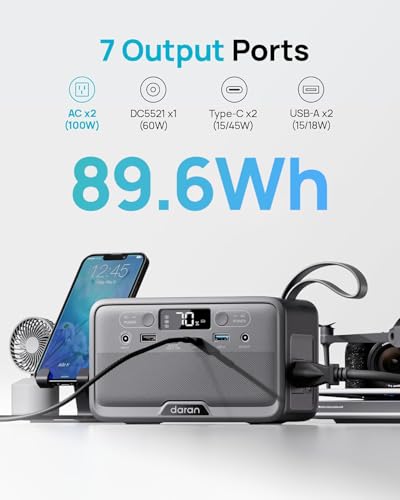
To convert mAh to Wh, you multiply the mAh rating by the voltage and divide by 1,000. For example, a 10,000 mAh power bank at 3.7 volts equals 37 Wh. A 20,000 mAh power bank at 3.7 volts equals 74 Wh. This is especially important if you're traveling by air, because airlines often have Wh limits for portable batteries. Most airlines allow power banks up to 100 Wh in carry-on luggage without special approval, and some allow up to 160 Wh with airline permission.
Understanding Wh also helps you compare power banks more fairly. Two power banks might both advertise 10,000 mAh, but if one operates at 3.7 volts and the other at 3.8 volts, they store slightly different amounts of total energy. Wh removes that ambiguity and gives you a clear, voltage-independent measurement.
How to Choose the Right mAh for Your Needs
Picking the right power bank capacity isn't about getting the biggest number possible. It's about matching the capacity to your actual lifestyle and devices. Over the years, I've learned to think of power banks in three broad categories that cover most use cases.
For daily commuters and light users, a 5,000 to 10,000 mAh power bank is usually plenty. This range is compact, lightweight, and can fully charge most smartphones one to three times. It fits easily in a pocket or small bag, and it's perfect for topping off your phone during a busy day when you can't get to an outlet.
For travelers and heavy users, a 10,000 to 20,000 mAh power bank hits the sweet spot. This capacity can charge a smartphone four to six times or fully charge a tablet once or twice. It's great for long flights, camping trips, or days when you're away from power for extended periods. Just keep in mind that higher capacity means more weight and bulk.
For power users and multi-device households, a 20,000 mAh or larger power bank makes sense. These are often called portable chargers for good reason. They can charge multiple devices, power laptops through USB-C, and keep everything running during outages. They're heavier and more expensive, but the convenience is worth it if you regularly need to charge several devices at once.
The key is to match capacity to your real needs. There's no point in carrying a heavy 30,000 mAh brick if you only need a quick top-up during your lunch break. Conversely, a tiny 3,000 mAh stick won't help you on a weekend camping trip. Think about how many times you typically need to charge your devices between outlets, then add a little extra for unexpected situations.
Common Myths About mAh in Power Banks
Over the years, I've heard plenty of myths and misconceptions about power bank capacity. Let me clear up a few of the most common ones that trip people up.
The first myth is that higher mAh always means more charges. As we covered earlier, real-world performance depends on voltage conversion, cell quality, and efficiency. A well-made 10,000 mAh power bank can easily outperform a poorly made 20,000 mAh one.
The second myth is that all power banks lose capacity at the same rate. Battery degradation depends on charge cycles, temperature, and how you treat the device. Storing your power bank in a cool, dry place and avoiding full discharges can significantly extend its lifespan.
The third myth is that mAh ratings are standardized across the industry. They're not. There's no universal testing standard, which means manufacturers can rate their batteries under ideal conditions that don't reflect real-world use. This is why independent reviews and hands-on testing are so valuable.
The fourth myth is that you should always fully drain your power bank before recharging. Modern lithium-ion batteries don't have the memory effect of older battery types. In fact, shallow discharge cycles are better for long-term health. Topping off your power bank whenever it's convenient is perfectly fine.

Tips to Maximize Your Power Bank's Performance
Getting the most out of your power bank isn't complicated, but a few simple habits can make a big difference in both performance and lifespan. Here are the tips I follow myself and recommend to anyone who relies on portable power.
Keep your power bank at a moderate temperature. Heat is the biggest enemy of lithium-ion batteries. Avoid leaving it in direct sunlight, in a hot car, or near heat sources. Cold temperatures can temporarily reduce capacity but don't cause permanent damage.
Use the right cable. A high-quality cable that supports fast charging can significantly reduce charging time and energy loss. Cheap or damaged cables often have higher resistance, which wastes energy as heat.
Don't wait until your power bank is completely dead to recharge it. Partial charges are better for battery health than full cycles. Try to keep it above 20 percent whenever possible.
Store it properly when not in use. If you won't use your power bank for a few months, store it at around 50 percent charge in a cool, dry place. Storing it fully charged or completely empty for long periods can reduce its overall lifespan.
Charge your devices efficiently. Turn off unnecessary features like Bluetooth and GPS while charging, and close apps that drain battery in the background. The less your phone pulls, the more efficient the overall charging process becomes.
How mAh Affects Charging Speed
While mAh primarily measures capacity, it also has an indirect effect on charging speed. Larger capacity power banks often support higher output currents, which means they can charge devices faster. However, the actual charging speed depends on the power bank's maximum output, the cable, and the device's charging capabilities.
Most modern power banks advertise output in watts or amps. A 10,000 mAh power bank with an 18-watt output can charge a compatible phone much faster than a 20,000 mAh power bank with only a 10-watt output. This is why it's worth looking beyond just the mAh number when choosing a power bank, especially if fast charging is important to you.
Technologies like Quick Charge, Power Delivery, and proprietary fast-charging standards have made speed a major selling point. A power bank with USB-C Power Delivery can even charge laptops and other high-powered devices, something traditional USB-A power banks simply can't do. If you want versatility and speed, look for a power bank that combines high mAh with modern fast-charging protocols.
Frequently Asked Questions
Does higher mAh mean a better power bank?
Not necessarily. Higher mAh means more stored energy, but actual performance depends on conversion efficiency, cell quality, and output capabilities. A well-designed 10,000 mAh power bank can outperform a poorly made 20,000 mAh one in real-world use.
How many times can a 10,000 mAh power bank charge a phone?
A good 10,000 mAh power bank with 85 to 90 percent efficiency can typically charge a 3,000 to 4,000 mAh smartphone two to three times. The exact number depends on your phone's battery size, charging speed, and how much charge your phone had when you plugged it in.
Is a 20,000 mAh power bank allowed on planes?
Most airlines allow power banks up to 100 Wh in carry-on luggage. A 20,000 mAh power bank at 3.7 volts equals 74 Wh, which is within the standard limit. Some airlines allow up to 160 Wh with special approval. Always check your airline's specific rules before flying.
Why does my power bank lose capacity over time?
All lithium-ion batteries degrade with use. Each charge cycle slightly reduces total capacity, and factors like heat, deep discharges, and poor storage conditions accelerate this process. After 300 to 500 full cycles, most power banks retain about 80 percent of their original capacity.
Can I use my power bank while it's charging?
Yes, most modern power banks support pass-through charging, but it generates more heat and can reduce overall battery lifespan. If you need to use it, try to keep the power bank cool and avoid heavy loads that cause excessive heat buildup.
Conclusion
Understanding what mAh means in a power bank is the key to making smart buying decisions and getting the real-world performance you expect. While higher mAh ratings generally mean more stored energy, the actual charge you receive depends on conversion efficiency, cell quality, voltage, and how you use the device. By learning to look beyond the number on the box and considering factors like watt-hours, output speed, and brand reputation, you can choose a power bank that truly fits your needs and avoid the frustration of underwhelming performance.
If you're shopping for a new power bank today, take a moment to think about how you actually use your devices. Match the capacity to your lifestyle, invest in quality from a trusted brand, and follow simple care tips to keep your power bank healthy for years to come. The right power bank isn't just about the biggest number, it's about reliable power when you need it most. Feel free to share your own power bank experiences or questions in the comments below.